

by Mark Palumbo
Director of Business Development, PanurgyOEM
This piece originally ran in Returns, Repairs, Reality — a private newsletter for operations and supply chain leaders in electronics manufacturing and distribution. It’s the third in a series that has been making one argument from three different angles. This one is the one most operations leaders don’t see coming until it’s already too late.
The first two editions of this newsletter made the same argument from two different angles. Every return demands a decision. And the clock starts the moment that return hits your dock.
Both of those things are true. But they assume something that isn’t always there: enough capacity to act on the decision once it’s made.
There’s a second path to value destruction that has nothing to do with hesitation or poor process. Your team knows exactly what to do with every unit in the queue. Repair it, refurbish it, move it. The decision isn’t the problem. The problem is that there are forty units behind it, three technicians on the floor, and it’s the third week of January.
That’s the elasticity problem. It doesn’t announce itself. It shows up as turnaround times that quietly stretch, customer service calls that start to climb, and a queue that grows faster than it shrinks. By the time it’s visible, the damage is already happening.
The Wave Is Predictable. The Damage Isn’t.
January has a nickname in reverse logistics circles: Returnuary. Between 20% and 25% of all holiday merchandise sold comes back, with electronics consistently among the top returned categories. Return requests spike 25% to 45% in the days immediately following Christmas and stay elevated for weeks.
Most operations leaders know this is coming. The calendar is not a surprise.
What makes it harder than it looks is the lag. Returns don’t flow directly from the consumer to the manufacturer. They move through retailers first, which means the wave hits your dock in January and February — compressed and concentrated — long after the holiday sales reports have been celebrated.
The volume is manageable, in theory. What it does in practice is expose something that was already there: the gap between the repair capacity you have on an average Tuesday and the repair capacity you need in the third week of January.
Why Electronics Repair Can’t Be Surge-Staffed Like a Warehouse
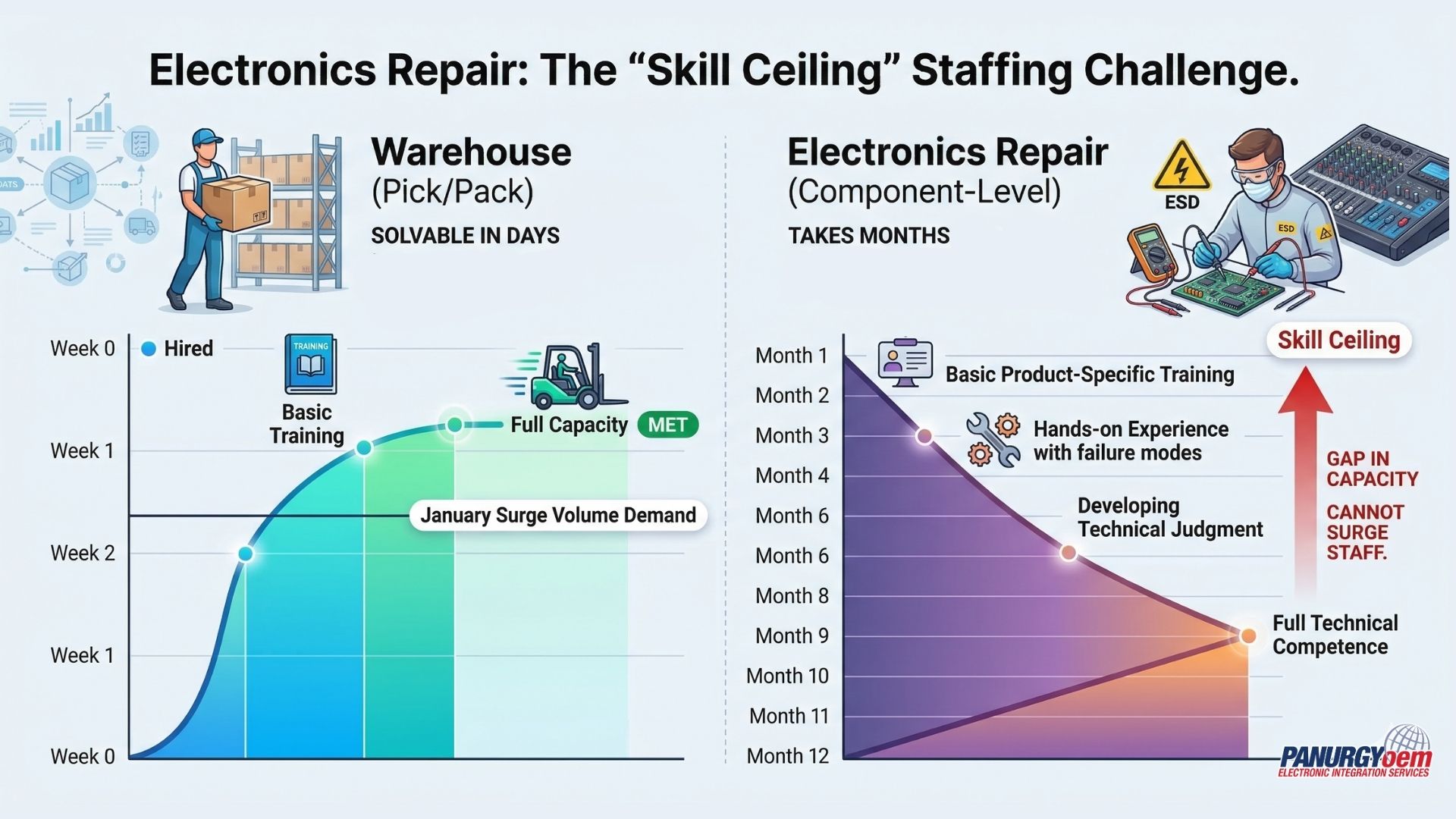
When a fulfillment center gets slammed in January, the staffing response is straightforward. Call the agency, bring in temporary pickers, run an extra shift. It isn’t painless, but it’s solvable in days.
Electronics repair doesn’t work that way.
Component-level diagnosis and repair requires product-specific training, hands-on experience with failure modes, and technical judgment that takes months to develop. You cannot pull someone off the street to troubleshoot a mixing board, a fitness console, or a commercial digital signage system. You cannot onboard a repair technician in a week and expect them to turn units in four days.
In-house repair teams are sized for average demand. That’s a rational decision. Carrying peak-season headcount year-round would be expensive and unnecessary for the ten months when volume is normal.
But when January arrives and the queue starts building, there is no bench. Overtime has a ceiling. Quality starts to slip before turnaround times do, and turnaround times follow shortly after.
This is where the elasticity problem connects directly to the value destruction argument from the first two editions. A growing queue isn’t just an operational inconvenience. It produces the same outcome as indecision — through a completely different mechanism.
Two Roads to the Same Cliff
When your repair operation is overwhelmed, decisions aren’t being avoided. They’re being delayed by the queue itself. The unit sitting in that backlog isn’t undecided. It’s waiting. And waiting costs money whether the cause is human hesitation or a floor with three technicians and forty units.
The product doesn’t know why it’s sitting still. The value loss is identical either way.
This is the part of the elasticity problem that rarely gets named directly. Indecision is one road to delay. Insufficient capacity is the other. They look different from the inside of your operation. From the perspective of the product losing value on your shelf, they are the same thing.
What Elasticity Actually Looks Like in Practice
Elasticity isn’t a staffing concept. It’s an operational design decision, and it has to be made long before January arrives.
The question is never how to hire more technicians during a volume spike. By the time the spike is visible, the answer to that question is: you can’t — not fast enough, not at the skill level you need. The question is whether your repair operation was built to absorb surge volume without changing its turnaround commitments.
That means cross-trained technicians who can shift between product lines when volume spikes in one area. It means facility scale and workstation capacity that treats peak demand as a design condition, not an exception. It means a single partner who owns enough of your repair volume that surge capacity is already built into their operation — not scrambled for after the fact.
When the wave hits a facility built this way, the 4-day turnaround holds. Not because of heroics, but because the capacity was already there.
That matters beyond customer satisfaction. A repair operation that holds its turnaround commitment in January keeps the product moving. And a product that keeps moving is a product that retains its value.
Three editions in, this newsletter has been making a single argument from three different angles. Every return deserves a fast decision. Every day of delay costs real money. And the operation behind you either has the capacity to honor both of those principles or it doesn’t.
The manufacturers who handle peak season well didn’t solve the problem in January. They solved it earlier — in the structural decision about where repair lives, how it’s resourced, and whether the partner handling it was built for surge volume or just average volume.
One question worth sitting with before next Q4: when your queue doubles, does your turnaround time hold?
If the honest answer is no — or you’re not sure — that’s the conversation worth having now.
These insights go out early to the 1,000+ electronics manufacturing and operations leaders who subscribe to Returns, Repairs, Reality on LinkedIn. If you want the next edition before it hits the blog, subscribe here: Returns, Repairs, Reality on LinkedIn