

by Mark Palumbo
Director of Business Development, PanurgyOEM
The Return That Came Back Working Is the One Most Likely to Be Written Off
This piece originally ran in Returns, Repairs, Reality — a private newsletter for operations and supply chain leaders in electronics manufacturing and distribution. It targets a blind spot that most returns operations never fully reckon with: the unit that isn’t broken is often the one that loses the most value.
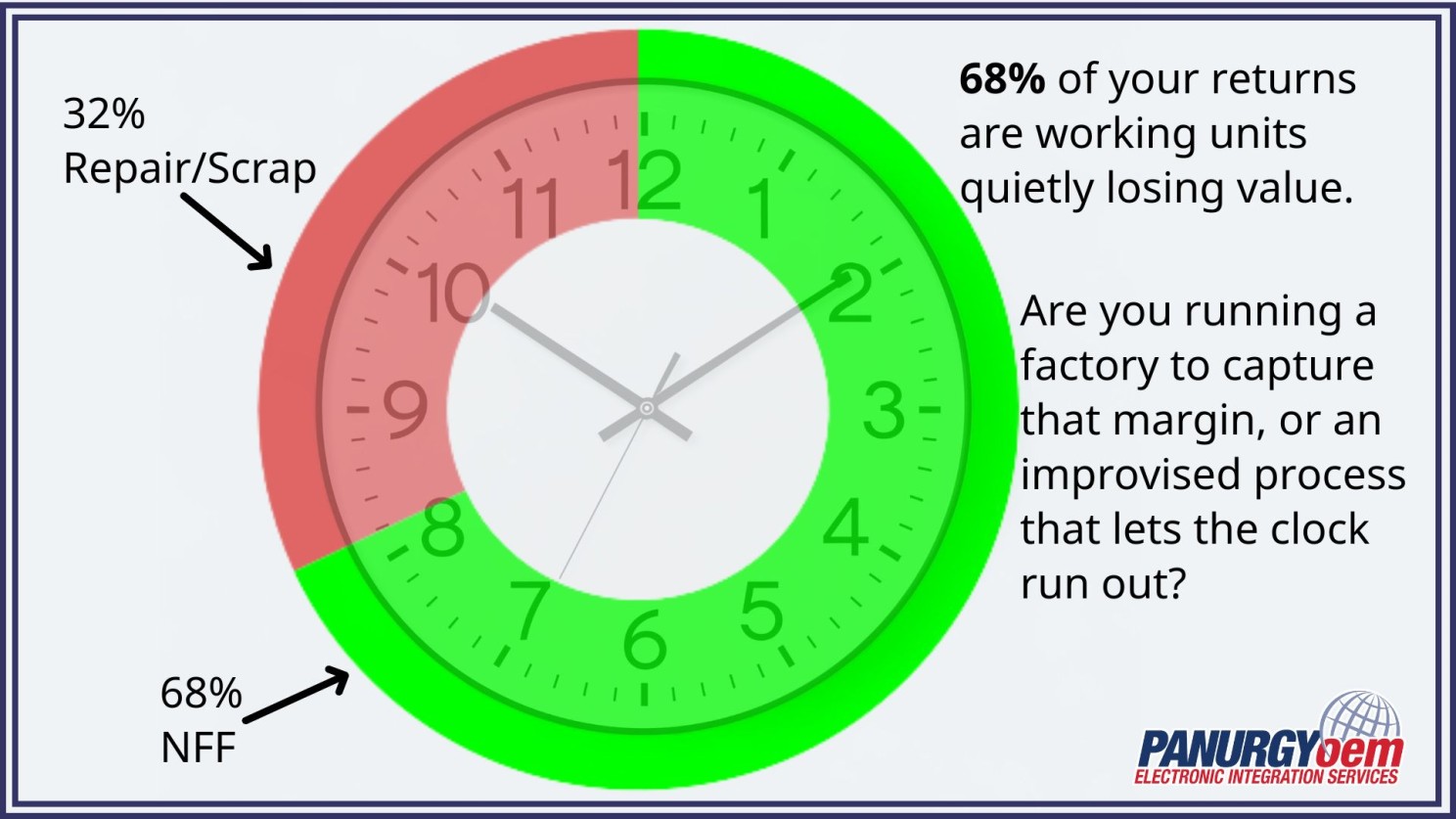
68% of consumer electronics returns are No Fault Found. More than two-thirds of what comes back to you isn’t broken. According to Accenture and TechSee, that number has held for years.
Most operations leaders have heard it. Fewer have sat with what it actually means for their margins.
The NFF Unit Is the Best-Case Return
Think about what an NFF return represents. It came back working. There is no fault to chase down, no component to replace, no complex repair standing between you and a sellable product. By every measure it should be the simplest problem in your returns operation.
And yet for most electronics manufacturers, it is where value quietly disappears.
Working Isn’t the Same as Sellable
Every NFF unit sitting in your returns operation has a clock running. The moment a new model launches, resale value on the previous generation drops. The moment a manufacturer ends software support, a segment of buyers disappears. These are not gradual declines. They can be sudden, and the dates are publicly known. Any buyer considering a refurbished unit can look up exactly when support ends before they decide whether to purchase.
The market for that unit is real and the window is open — for now.
That market is active and someone is supplying it. The buyer who purchases a one-generation-old device knows what they are getting. They know the support timeline. They buy anyway because the value proposition is clear.
That market exists right now for the units sitting in your warehouse. It may not exist in the same form six months from now.
The Cannibalization Concern
Most manufacturers won’t sell refurbished units directly back to their own customer base, and that instinct is reasonable. The alternate channel exists for exactly this reason. Apple, Dell, and Samsung all sell refurbished products — just not on the same shelf as new. The buyer shopping for a one-generation-old device at a significant discount was not going to pay full retail for the current model. You are not cannibalizing your new product line. You are recovering value from inventory that would otherwise write itself off.
The Factory Problem
Getting an NFF unit from receipt to sellable condition isn’t complicated. Receive it. Inspect it. Run a pass/fail test against an established routine. Clean it. Kit it. Pack it. Get it into inventory and connected to a sales channel. Four days or less, every time.
Simple to describe. Harder to actually have running when the returns arrive.
Most manufacturers don’t have that factory built. They have people and good intentions, and those are not the same thing. A pass/fail test sounds straightforward until there is no established routine, no dedicated staff, and no process that doesn’t depend on whoever happens to be available that day.
The difference between a factory and an improvised process is repeatability. One runs the same way on a slow Tuesday as it does the week after the holidays. The unit moves. The value is captured.
The Capacity Problem Compounds It
Even a well-built factory has a ceiling. Return volume is not flat. It spikes after product launches, after the holidays, after promotions. When volume exceeds what the core team can handle, units stack up.
The process doesn’t fail. The capacity does.
That is where elasticity matters. The ability to surge throughput when volume demands it — without retraining staff or rebuilding the process from scratch — is what keeps the factory running when it matters most. Without it, the units sit. And while they sit, the clock that the manufacturer set, not you, keeps running.
No Fault Found Is Not the Finish Line
It is the starting line of a race with a deadline.
Building that factory — the process, the staffing, the elastic capacity behind it — is solvable. It is what we have spent 40 years doing for electronics manufacturers who decided their time was better spent building products than processing returns.
These insights go out early to the 1,000+ electronics manufacturing and operations leaders who subscribe to Returns, Repairs, Reality on LinkedIn. If you want the next edition before it hits the blog, subscribe here: Returns, Repairs, Reality on LinkedIn