

by Mark Palumbo
Director of Business Development, PanurgyOEM
Introduction
Here’s something I’ve noticed over the years. When you ask most operations leaders how their returns are being handled, they’ll tell you it’s covered. One vendor is responsible for returns. There’s someone doing repairs. There’s a warehouse holding the inventory. Their reverse logistics program is all set.
But having vendors is not the same as owning outcomes.
All the pieces being in place gives you the feeling of a system without actually having one. When no single partner is responsible for the full lifecycle of a return, nobody is accountable. Accountability dissolves into the gaps between vendors, into the handoffs, and into the write-offs that show up at quarter-end with no clear explanation.
That’s what returns fragmentation looks like. Not chaos. Not an obvious failure. Just a quiet, consistent leak that’s very hard to see until you go looking for it.
Part 1: Fragmented Reverse Logistics
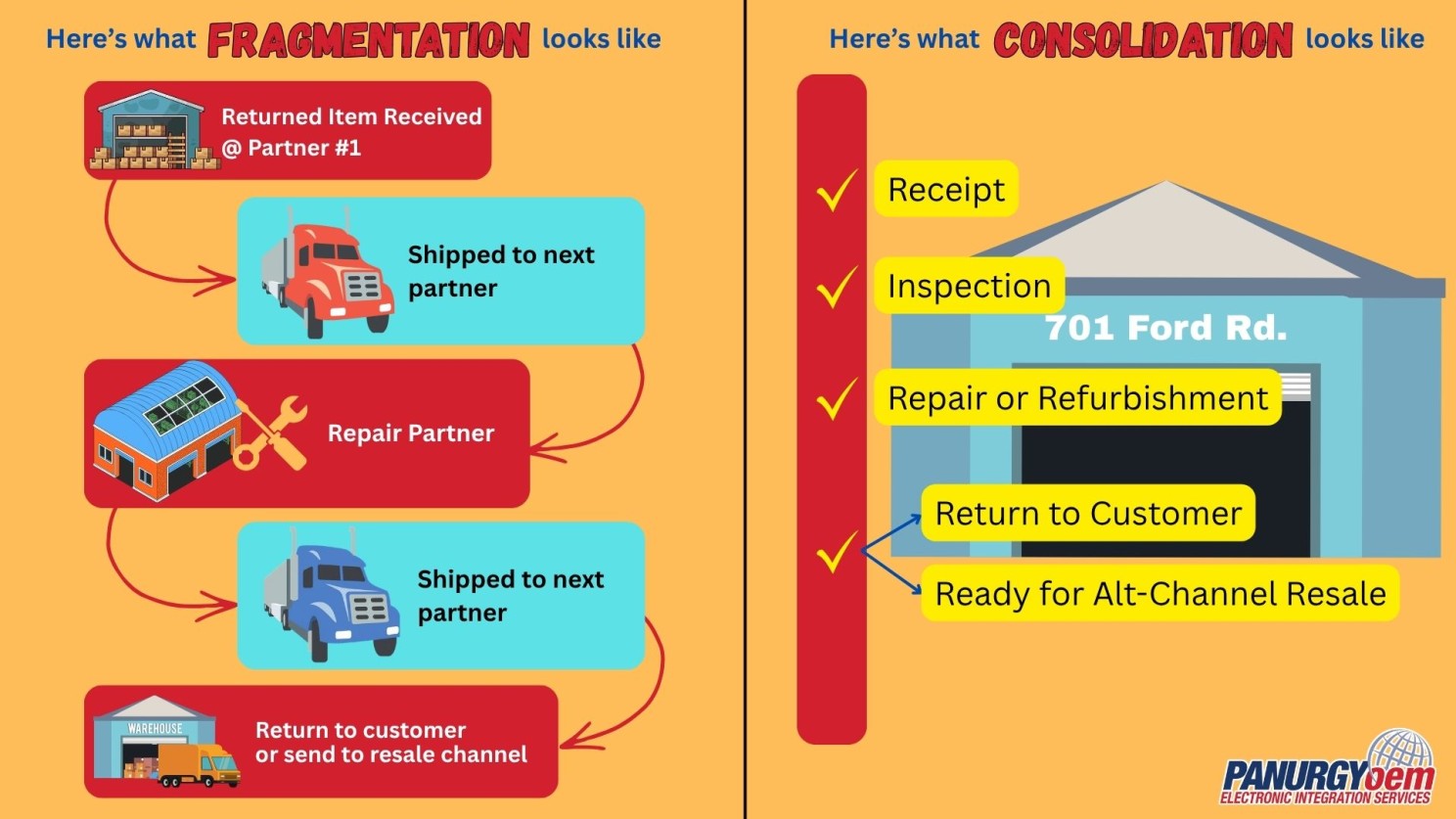
The multi-stop model is a common approach I see. A return comes in at one facility, gets shipped to a repair center, and then moves to a warehouse for disposition or to await resale. Each stop makes sense in isolation. The problems live between them.
Every transfer between facilities adds freight cost, handling time, and another opportunity for something to go wrong. A unit in transit between vendors is essentially invisible. Nobody knows exactly where it is in the recovery cycle or what it’s worth at that moment. Meanwhile, someone on your internal team is chasing status updates and reconciling discrepancies between vendors who don’t communicate with each other. That’s overhead that produces nothing.
And the clock is running. Every day a return spends waiting for the next handoff is a day its resale value drops.
When something goes wrong, you get a predictable response. Each vendor has a reasonable explanation for their piece of it, and nobody is wrong exactly. But nobody owns the outcome either. Vendor #1 is measured on intake speed. Vendor #2 on repair quality. Vendor #3 on fulfillment accuracy. Nobody is measured on total recovery value or total cycle time.
In practice, a unit that comes back in week one might not reach saleable condition until week six. By then the model has aged, comparable units are selling for less, and the recovery window has narrowed. Finance sees the write-off. The why is clear, the unit spent more time moving between vendors than it did getting fixed.
Part 2: Fragmented Service Networks
Many manufacturers build their post-sale service network by authorizing independent repair centers across different regions. The logic is sound. More locations means more coverage. The problem is that coverage and consistency are not the same thing.
Every independent service center is its own company, with its own training standards and its own interpretation of what a complete repair looks like. A customer in one region has their unit back in four days. A customer in another region is still waiting after three weeks. Both represent your authorized service network. The customer doesn’t care about the network. They care about their repair. The manufacturer cares deeply about the network, because inconsistency across it means every customer gets a different version of your brand.
A distributed network also means distributed parts inventory. A part that’s on the shelf in Nebraska might be backordered in Arizona, and that customer waits while the supply chain sorts itself out.
When volume spikes, each independent center absorbs the pressure alone. A centralized operation can redeploy cross-trained staff to wherever it’s needed. An independent service center just gets backed up. You find out when customers start calling (or slamming you on social media). And as the manufacturer, you have no real lever to pull. You can ask. You cannot redirect.
Managing all of this is a significant internal burden. You expect consistent training across the network, but enforcing that across independent companies is harder than it sounds. Add separate contacts, separate reporting formats, and separate escalation paths, and your team is spending its time managing the complexity of the network rather than managing the outcomes it produces.
Part 3: The Common Thread
Both problems come from the same place. Distributed ownership produces distributed results, and distributed results are hard to manage, hard to measure, and expensive to fix. The costs don’t show up in a single line item. They accumulate across freight invoices, write-offs, customer complaints, and staff hours spent on coordination work that shouldn’t need to exist.
Partner fragmentation is a slow, invisible drain on your margin that nobody catches until they specifically go looking for it.
The manufacturers who have solved this have one thing in common. They found a single partner who owns the return from arrival to repair or refurbishment and on to the customer or the resale channel.
When ownership consolidates, accountability follows. When accountability follows, outcomes improve. And the invisible costs end.
That’s the difference between a fragmented network of vendors each owning a piece, and a single consolidated partner who owns the result.
Is a fragmented returns network affecting your brand’s reputation or bottom line? DM me, let’s talk.